JEV and Its Open-Source Alternatives: When a Decision Model Beats a Chatbot
Listen to this article · 6 min
AI-generated voice0:00 / 5:34
Listen to this article · AI-generated voice
JEV and Its Open-Source Alternatives: When a Decision Model Beats a Chatbot
0:00 / 5:34

A Lot of AI Work Is Really a Tiny Decision
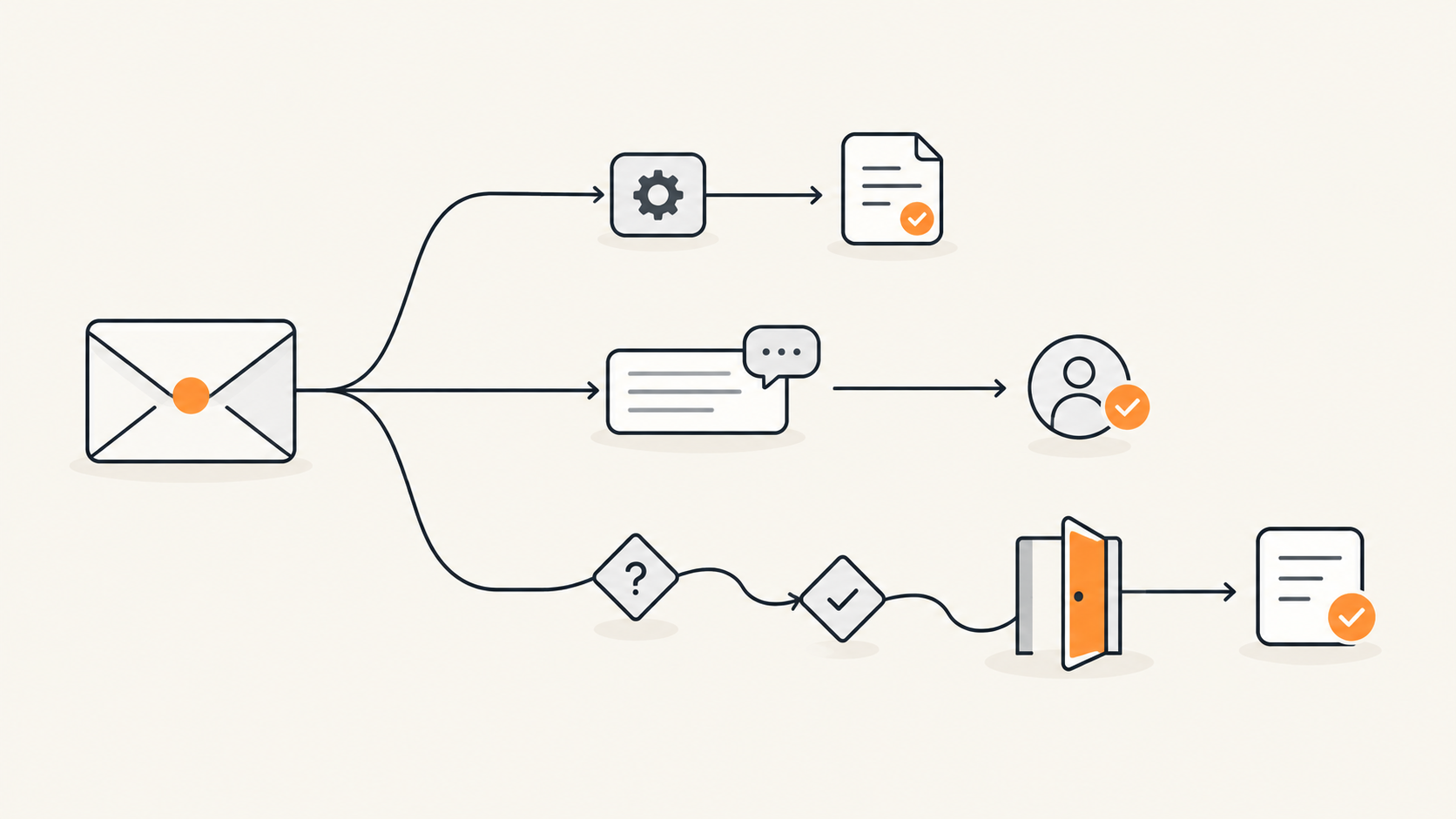
Which team should get this ticket? Is this email a complaint? How urgent is this lead? A lot of the AI work inside business software isn't conversation. It's a quick judgement, repeated thousands of times a day.
Chat models can do it, but they're slow and costly for the job, and their answers still need parsing. In September, a model built for nothing but these decisions went viral, and open-source rivals followed within days.
What Jev Actually Does
TypeSafe AI, a San Francisco startup, released Jev in early access on 15 September 2026. It doesn't write text. You send it your application's state and a set of typed questions, and it returns a choice, a yes/no judgement or a score, each with a probability attached.
TypeSafe's numbers are striking: answers in 70 to 500 milliseconds and $0.042 per million input tokens, with output free. Because every answer must be one of the options you defined, Jev can't return a malformed result, although it can still pick the wrong option.
The company is unusually open about the caveats. It admits it can't prove the price isn't subsidised, and that its own team built the workflows behind its benchmarks. Developers piled in anyway: a September study counted 2,170 public projects using Jev, with routing and automation drawing the most attention.
The Open-Source Alternatives Worth Knowing
TypeSafe hasn't published Jev's weights or full training recipe, so none of the open projects is a true copy. Most are built on generative language models such as Qwen, and several simply read answer probabilities off them, which ranks the options without calibrating them the way Jev claims to.
Laya is the exception. It's a dedicated decision model based on ModernBERT, released under Apache 2.0 with a separate multilingual checkpoint and its own calibration training, and its author's benchmarks put it 6 to 8 times faster than published measurements of Jev, at roughly 33 to 40 milliseconds per call on one T4 GPU. Its model card is frank about the catch: without fine-tuning, it scores below simply guessing the most common answer on a typed-decisions benchmark.
Kev takes another route: small models built on Qwen3.5, from 0.8 to 9 billion parameters, that speak Jev's own API format, so code written for Jev can point at your server instead. On the development set in Kev's README, its 9B model scores 0.812 against Jev's 0.857, and the author stresses this isn't a controlled comparison. OpenJev, on Hugging Face, claims to sit within 1.4 points of hosted Jev on 10,000 questions, though that figure is also self-reported.
Hosted or Self-Hosted?
Jev is hosted only. You call TypeSafe's API, which the company says is currently based on the US West Coast, or reach it through AI gateways such as Vercel's, Cloudflare's or OpenRouter's. OpenAI announced a competing Decisions API on 29 September, but in early October it was still limited to selected customers, with no public documentation or pricing.
For a European business, the case for an open model is rarely price: at Jev's listed rate, your own GPU is unlikely to be cheaper. The case is control. Customer emails and tickets never leave your servers, and nobody can change the model or the price under you.
Language is the other test. Laya's model card warns that its English checkpoint collapses on non-Latin scripts while staying confident: on Khmer text it scored 0% accuracy at 95% confidence. Bulgarian is written in Cyrillic, so route it to a multilingual model and test it on real messages first.
Where a Decision Model Fits
The pattern is simple: your code gathers the facts, the model makes one narrow judgement, and your code acts on it. The model never sends an email or edits a record itself, which makes it far easier to test than an always-on agent like OpenAI's dots. AI integration services for existing software use the same split: the model decides, and your system's own code acts.
Customer support is the classic fit, and Arc AI, a Software engineering team, builds these systems. Its portfolio includes a multi-agent chatbot that authenticates users and resolves tickets, and a voice agent that runs scripted scenarios and collects service data. Steps like routing a request or flagging an angry customer are exactly what a fast decision model can take off a slower, pricier one.
How to Try One Without Betting the Business
Pick one decision you already make by hand or with a chat model, and collect a few hundred real examples with the right answers. Run Jev and one open model against them, then compare accuracy, speed and how often each is confidently wrong. That last number matters most, because a confident mistake is the one your code won't catch, as the Khmer result shows.
Watch for quiet mistakes at scale. One AI-driven import created 790 duplicate records because "not found" silently became "new".
Arc AI's process starts by understanding the system, then challenging the obvious fix, including whether AI is needed at all. Sometimes a plain rule beats any model.
Start With One Decision
A decision model won't replace your agents or your developers. It replaces the slow, fragile if-statement in the middle of a workflow. If you'd like help choosing a model or wiring one into an existing system, talk to an engineer who has done this before.